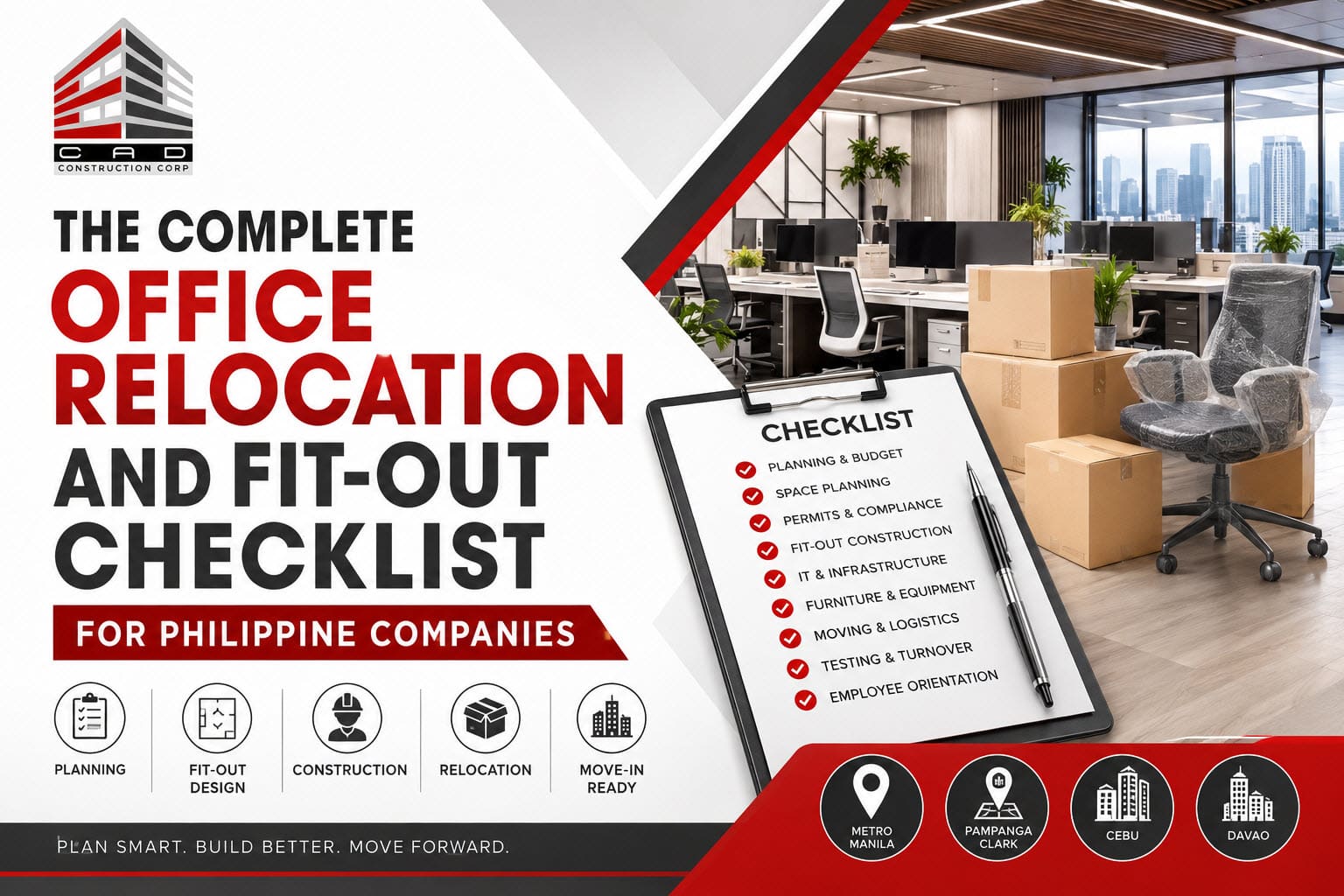
The Complete Office Relocation and Fit-Out Checklist for Philippine Companies
Relocating to a new workplace requires careful planning, budgeting, coordination, and execution. A complete Philippine Office Relocation Checklist helps companies manage every stage of the move, from selecting a new office and planning the layout to completing the fit-out, transferring equipment, and preparing employees for move-in. Therefore, businesses can use a structured checklist to reduce delays, control costs, and minimize disruption to daily operations.
Whether a company is expanding, downsizing, opening a new branch, or moving to a more strategic location, office relocation involves much more than moving desks and computers. Companies must coordinate office design, construction, building approvals, IT infrastructure, furniture, logistics, and business continuity.
For businesses relocating within Metro Manila, Makati, BGC, Ortigas, Quezon City, Pampanga, Clark, Cavite, Laguna, Cebu, Davao, and other growing business hubs, early preparation can make the transition significantly smoother.
1. Philippine Office Relocation Checklist: Define Your Business Objectives
Before searching for a new office, clearly identify the reason for the relocation. This first step will guide your decisions about location, office size, workplace design, and project budget.
Common reasons for relocation include:
- Business expansion and workforce growth
- Lower operating or rental costs
- Better access to employees and customers
- Expansion into new business locations
- Improved workplace efficiency
- Consolidation of multiple offices
- A need for a more modern and collaborative workplace
Additionally, companies should consider projected headcount, hybrid work arrangements, client requirements, technology needs, and future expansion plans.
For example, a growing BPO company may require a high-density workstation layout and large training rooms. Meanwhile, a corporate headquarters may prioritize meeting spaces, executive offices, collaboration areas, and client-facing facilities.
Therefore, companies should define their operational requirements before finalizing a lease or starting the office design process.
2. Philippine Office Relocation Checklist: Set a Complete Budget
A realistic budget is one of the most important parts of any Philippine Office Relocation Checklist. Companies should calculate more than the basic construction cost because several activities contribute to the total project investment.
Your budget should include:
- Office design and space planning
- Fit-out construction
- Mechanical, electrical, plumbing, and fire protection works
- Structured cabling and IT infrastructure
- Office furniture and equipment
- Building and project requirements
- Moving and logistics
- Temporary operational expenses
- Contingency funds
Moreover, the design complexity, office size, location, existing site condition, and quality of finishes can affect the total cost.
For additional planning guidance, businesses can review ELCAD’s Office Fit-Out Cost Philippines Corporate Guide.
3. Philippine Office Relocation Checklist: Inspect the New Office Space
Before finalizing the office design, conduct a detailed site inspection. This allows the project team to understand the actual condition of the space and identify potential challenges early.
During the inspection, evaluate the following:
- Ceiling height and existing conditions
- Electrical capacity
- Air-conditioning and ventilation provisions
- Plumbing locations
- Fire protection systems
- Building restrictions
- Loading and delivery access
- Internet and telecommunications availability
In addition, review the building’s fit-out guidelines before construction begins. Commercial buildings often have specific rules regarding contractor accreditation, working hours, material deliveries, safety procedures, and construction activities.
As a result, early coordination with building management can help prevent unnecessary delays.
You can also learn more about the overall process through ELCAD’s office fit-out process.
4. Create an Office Layout That Supports Daily Operations
A successful office relocation should improve the way employees work. Therefore, companies should design the new space around actual operational requirements rather than simply copying the previous office layout.
Depending on the business, the office may include:
- Reception and waiting areas
- Open workstations
- Private offices
- Meeting and conference rooms
- Training rooms
- Collaboration spaces
- Pantry and employee amenities
- IT and server rooms
- Storage areas
- Breakout or wellness spaces
For BPO and call center companies, the workplace may also require high-density workstation planning, acoustic treatment, reliable data infrastructure, and carefully coordinated electrical systems.
Furthermore, effective space planning can help companies maximize their leased area while improving employee comfort and productivity.
5. Philippine Office Relocation Checklist for Permits and Compliance
Companies should address permits and compliance requirements early in the project. Waiting until construction is nearly complete can create unnecessary complications.
Depending on the project scope, location, building requirements, and occupancy type, an office project may require approved plans, permits, fire safety documentation, inspections, and occupancy-related requirements.
Therefore, companies should coordinate with:
- Building management
- Qualified design professionals
- The office fit-out contractor
- Relevant government agencies
For projects inside economic zones, businesses may also need to follow specific requirements. For example, the Philippine Economic Zone Authority provides guidance and resources related to development and business operations within PEZA zones.
However, every project has different requirements. Companies should confirm the specific permits and approvals that apply to their office location and construction scope.
6. Choose the Right Office Fit-Out Contractor
Selecting an experienced contractor can significantly improve project coordination. Therefore, companies should evaluate potential contractors based on relevant commercial project experience rather than price alone.
Consider the following factors:
- Experience with corporate office projects
- Design-and-build capabilities
- Engineering and MEPF coordination
- Experience with BPO or high-density workplaces
- Project management systems
- Quality control procedures
- Workplace safety practices
- Ability to coordinate with building management
- Relevant completed projects
Additionally, businesses should review the contractor’s construction process and communication procedures.
For a better understanding of the project stages, you can read ELCAD’s step-by-step fit-out construction guide.
7. Coordinate IT, Telecom, and Business Continuity
Technology planning is another essential part of a Philippine Office Relocation Checklist. A newly completed office cannot support normal operations until the required IT and communication systems function correctly.
Therefore, companies should coordinate early with their internal IT team and external service providers.
The technology checklist should include:
- Internet connectivity
- Structured cabling
- Network equipment
- Telephone systems
- Server requirements
- CCTV
- Access control
- Backup systems
- Testing and commissioning
For businesses that operate continuously, such as BPO companies, customer service centers, financial institutions, and technology firms, downtime can create significant operational challenges.
As a result, a phased relocation, weekend move, or after-hours transfer may help minimize disruption.
8. Plan Moving, Furniture, and Asset Transfers
Before moving day, conduct a complete inventory of company assets. Then, determine which items the company will transfer, reuse, refurbish, store, dispose of, or replace.
The moving plan should include:
- Office furniture
- Computers and monitors
- Network equipment
- Departmental equipment
- Files and records
- Storage items
- Employee belongings
Additionally, companies should label equipment and assets according to departments or assigned locations. This simple step can make unpacking and installation much more efficient.
A dedicated relocation coordinator can also help manage communication between management, employees, contractors, movers, IT providers, and building administration.
9. Philippine Office Relocation Checklist for Testing and Turnover
Construction completion does not automatically mean that the office is ready for employees. Before move-in, the company should conduct a final inspection and test all critical systems.
The final turnover checklist should include:
- Electrical systems
- Lighting
- Air-conditioning and ventilation
- Plumbing fixtures
- Data and telecommunications
- Internet connectivity
- Fire and life-safety systems
- Access control
- CCTV
- Doors and hardware
- Furniture installation
Moreover, the project team should conduct a final walkthrough to identify outstanding items and complete necessary corrections.
The contractor should also provide relevant turnover documents, warranties, and project information. Additionally, companies should confirm applicable fire safety requirements with the appropriate authorities, including the Bureau of Fire Protection.
10. Prepare Employees for the New Office
Office relocation also affects employees. Therefore, companies should communicate important information before the move.
Employees should receive details about:
- The new office address
- Transportation and access options
- Move-in dates
- Seating arrangements
- New workplace policies
- Access procedures
- Emergency exits
- Available office facilities
Furthermore, a short orientation can help employees become familiar with meeting rooms, collaboration areas, workplace technology, access systems, and emergency procedures.
As a result, employees can adapt more quickly to the new workplace.
Final Philippine Office Relocation Checklist for a Smooth Move
A successful office move requires coordination between business planning, workplace design, construction, compliance, technology, logistics, and employee communication. Therefore, using a complete Philippine Office Relocation Checklist can help companies manage these activities in a more organized way.
Instead of treating relocation and fit-out as separate projects, businesses should coordinate them under one clear schedule. This approach helps align construction, IT installation, furniture delivery, system testing, and employee move-in.
Whether your company is relocating within Metro Manila, opening an office in Pampanga or Clark, expanding into Cebu or Davao, or moving to a more efficient corporate workspace, careful planning can reduce operational disruption and support long-term growth.
Before setting a final move-in date, businesses can also review ELCAD’s Office Fit-Out Timeline Guide for the Philippines. For additional planning insights, you may also read the Office Relocation Basics Guide.
Ultimately, a well-managed Philippine Office Relocation Checklist helps transform a complex office move into a structured business opportunity. With early planning, proper coordination, and an experienced project team, Philippine companies can create a more efficient, productive, and future-ready workplace.
Frequently Asked Questions About Office Relocation and Fit-Out in the Philippines
1. What should be included in an office relocation checklist in the Philippines?
A complete office relocation checklist should include budgeting, site selection, lease and building requirements, space planning, office design, fit-out construction, permits, IT and telecommunications, furniture, moving logistics, employee communication, system testing, and final turnover. Companies should begin planning several months before their target move-in date, especially for large offices, BPO facilities, and projects requiring extensive construction work.
2. How long does an office relocation and fit-out take in the Philippines?
The timeline depends on the office size, design complexity, existing site conditions, permit requirements, availability of materials, and scope of construction. Small office projects may take several weeks, while medium to large corporate offices can require several months from planning and design through construction and final turnover. Companies should establish their target move-in date early and allow additional time for approvals, procurement, testing, and possible project adjustments.
3. What permits are needed for an office fit-out in the Philippines?
The permits and approvals required for an office fit-out depend on the project scope, building regulations, location, and type of occupancy. Requirements may include approved construction plans, building or ancillary permits, electrical and mechanical documentation, fire safety requirements, inspections, and occupancy-related approvals. Companies should coordinate with building management, qualified professionals, their fit-out contractor, and the appropriate government agencies to confirm the requirements for their specific project.
4. How much should a company budget for an office relocation and fit-out?
An office relocation and fit-out budget should cover more than construction costs. Companies should include office design, space planning, construction, MEPF works, IT and structured cabling, furniture, permits, moving services, temporary operational expenses, and contingency funds. The total investment will vary depending on the office size, location, design specifications, quality of finishes, technical requirements, and existing condition of the space.
5. When should a company start planning an office relocation?
Companies should begin planning an office relocation as early as possible, ideally several months before the intended move-in date. Early planning provides more time for office space selection, lease negotiations, design development, contractor selection, building approvals, permits, material procurement, construction, and IT coordination. Larger offices and BPO facilities may require a longer preparation period.
6. Should office relocation and office fit-out be planned together?
Yes. Planning office relocation and fit-out together can improve project coordination and reduce the risk of delays. The office layout affects furniture placement, electrical requirements, data cabling, network infrastructure, access control, and moving logistics. By coordinating these activities under one project plan, companies can better align construction completion, system testing, furniture installation, and employee move-in.
7. What should companies look for in an office fit-out contractor?
Companies should look for a contractor with relevant experience in commercial office projects, workplace construction, engineering coordination, project management, quality control, and safety. Businesses with specialized requirements, such as BPO companies, call centers, technology firms, or large corporate offices, should also evaluate the contractor’s experience with high-density workspaces, training rooms, meeting facilities, IT infrastructure, and complex MEPF systems.
8. How can companies minimize downtime during an office relocation?
Companies can minimize operational disruption by creating a detailed relocation schedule and coordinating construction, IT setup, equipment transfer, and employee movement in advance. A phased relocation, weekend move, or after-hours transfer may be appropriate for businesses that need to maintain continuous operations. Testing internet connections, network systems, access controls, and essential equipment before employees arrive can also help prevent unexpected downtime.
9. What should be inspected before moving into a new office?
Before occupancy, companies should inspect the completed office and test critical systems. These include electrical installations, lighting, air-conditioning, ventilation, plumbing, fire and life-safety systems, structured cabling, internet connectivity, telecommunications, access control, CCTV, and installed furniture. A final walkthrough with the contractor can help identify and resolve outstanding issues before employee move-in.
10. Why is office relocation an opportunity to improve the workplace?
Office relocation gives companies an opportunity to redesign their workplace around current business and employee needs. A new office can improve space utilization, support hybrid work, create better collaboration areas, upgrade technology, improve employee amenities, and strengthen the company’s professional image. Instead of simply transferring the existing workplace to a new location, businesses can use relocation to create a more productive and future-ready office.